Salena Khawaja: Youngest person to summit 7000m mountain, now eyes Mt Everest

https://www.youtube.com/watch?v=RUs3OuaAw8A&t=6s

By Faran Rafi

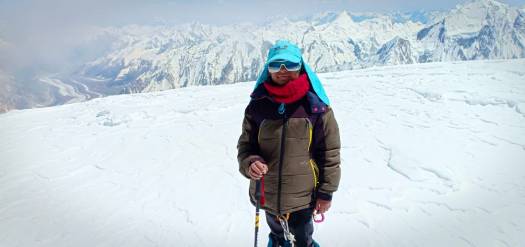
Young Salena Khawaja stepped out of her kitchen holding her favourite breakfast – buttered toast and mango milkshake. She was recuperating after her return from her recent expedition in the mountains. She summitted the 7027 meter high Spantik Peak, also known as the Golden Peak, becoming the youngest person in the world to reach the peak of a 7000-meter-high mountain.

Ten-year-old Salena, lives in Abbottabad with her father. Their house is attached to a massive gym owned by father – Yousaf Khawaja. Selena gave our team a tour of the gym, which housed more than a 100 different machines for various exercises.

One wall of her house is made of glass. You can see the hilly surroundings of Abbottabad – a famous tourist hub in Pakistan. Selena points to the tallest mountain on the horizon and says, “that’s the Miranjani peak, my father and I used to go for leisure trips to the mountain and that’s how I developed interest for mountaineering.”
WhatsApp Image 2019-08-03 at 12.26.39 PM

Yousaf, Salena’s father, is a fitness instructor by profession. “She was fit from childhood but I did not know what kind of sport she would be into,” he said, adding, “When I took her for trekking in the mountains, she performed much better than my expectations and I realised she could be fit enough to climb even Mount Everest.”

Apart from training on the Miranjani peak, Salena has also undertaken a level one basic mountaineering course as well. “In the gym, I use the treadmill, cycle, elliptical, stepper. Cardio is important for what I do, but I also do strength training,” she says, talking about how she keeps herself fit for mountaineering.

She took us on a hiking trail on the mountains surrounding her small hometown. Running up the hill, she talked about the dangers of mountaineering, she said, “there are avalanches and crevices that you have to watch out for, there could also be a storm which could blow away your things.”

Reminiscing about her expedition up the mountain, she recalls, “when we were at camp 1, there was a big wind storm, my mittens and jacket blew away. We had to leave for the next push at 1am and I felt really cold, my hands were freezing and I wanted to give up, but then my father reminded me that sun will come up in a few hours and I will be okay.” She went to say that she doesn’t get scared of these things anymore and is well prepared for such adventures in the future.

“When you’re looking at the peaks from the base-camp, there is snow on the top. It turns into a really nice scene, especially when the sun is about to set and the mountains turns lightly golden.”

Talking about her naysayer, she said “Some people used to say you are too young for these kinds of activities, maybe you can wait till you grow up. I used to say, no I have the training for this and I am fit enough and I can do it.”

Having broken the record for being the youngest mountaineer in the world to climb a 7000 meter mountain, Selena had no plans to stop anytime in the near future. She says she is planning to make an attempt for the Mount Everest next year.

Currently the record of youngest person to summit Mount Everest is held by Jordan Romero of United States, who summitted the Everest at the age of 13 years and 10 months. The youngest female to summit the Everest is Malavath Purna, who summitted the Everest at the age of 13 years and 11 months. Salena, who will be 11 years old next year, will break both of their records by more than two years.

Yousaf Khawaja has high hopes for his daughter, but he says this trip to Everest is dependent on whether they can arrange for the funds or not.

Originally published in BBC Urdu

Polio: The Final Battle

In this in-depth story, we trace the history of Pakistan’s polio vaccination campaign, which is marred with violent backlash and propaganda. Here we follow some unsung heroes of the polio campaign in Pakistan to understand the challenges of polio eradication.

Shorthand can be read at: https://www.bbc.co.uk/news/extra/AETmcEnXRC/polio_the_final_battle

Here is the video, with condensed information:

IPL vs PSL

Indian Premier League is the biggest cricket league in India. While it enjoyed much fame in Pakistan, during its initial seasons… it is now completely banned in Pakistan. Do Pakistani cricket enthusiasts still watch IPL? Should sports and politics be mixed? I asked players of a local cricket club in Islamabad.

Asia Bibi – Pakistan’s notorious blasphemy case


We did an in-depth investigation into the history of Pakistan’s blasphemy law and the problems that have been cause as a result of it. Using Asia Bibi’s case as an opening, we met different characters around Pakistan who were somehow involved in the bigger picture of blasphemy law – either its support or opposition.

The pictures for this story were taken by me,  while I also did the production for it.

You can read the story here: https://www.bbc.co.uk/news/resources/idt-sh/Asia_Bibi

BBC She series in Pakistan

In winter 2018, I produced a month-long series under the title of “BBC She”. This campaign was introduced to increase the outreach of women’s voices from the grassroots of Pakistan. In the first phase of the campaign, our team went to four different cities in each province of Pakistan to talk to young university students.

This series ran simultaneously on BBC Urdu and BBC Hindi.

During these hour-long townhall style discussions, we got to hear some very smart, confident and fierce women. Here are the condensed version of discussions from each city.

Episode 1: Quetta, Balochistan


Episode 2: Larkana, Sindh


Episode 3: Abbotabad, Khyber Pakhtunkhwa


Episode 4: Lahore, Punjab

Pakistan’s Generation-Z goes to vote

by Faran Rafi

People born after mid-90s till mid-00s are called Generation Z. The Pakistani Generation Z will be voting in these elections for the very first time. Roughly 12 per cent of Pakistan’s population is between the ages of 18 to 24. We sat down with three individuals from Generation Z and asked them about the aspirations and expectations from the upcoming election.


Also published on BBC Urdu

Pakistan’s first blind judge set to take oath

by Faran Rafi

Yousaf Saleem from Lahore won a gold medal from University of Punjab in his law degree (LLB) in 2014. He then went on to practice law for two years, fulfilled all the requirements to become a judge and even topped the competitive exams out of 6500 applicants. But during the interview, he was failed and told that he could not become a judge. The reason? Yousaf is blind.

25-year-old Yousaf suffers from a rare genetic disorder called Retinitis Pigmentosa (or RP). Due to this, his vision was only 30-40 per cent when he was a child, but overtime it has completely deteriorated and now he only has light perception.

The chief justice of Pakistan, Justice Saqib Nisar, then took a suo motu notice of this and directed the Lahore High Court to reconsider the matter. His case was reconsidered by the selection committee and Yousaf was selected for the post. He is now set to become Pakistan’s first blind judge.

IMG_1343

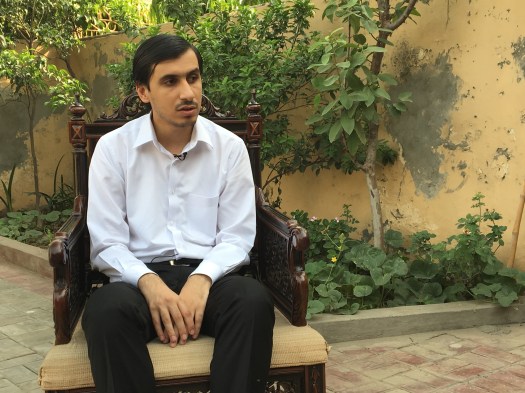
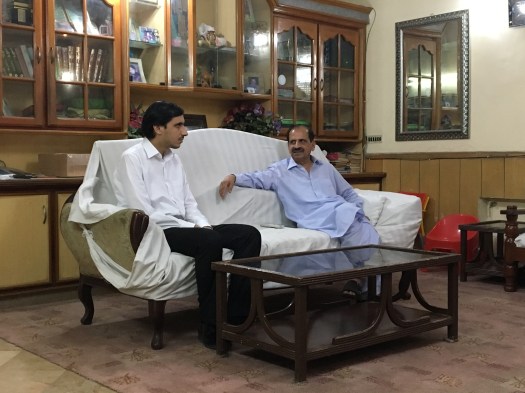
I met Yousaf at his home in Lahore. As he entered the room, I got up to help him find his way around and sit down. But before I could take a few steps, he swiftly manoeuvred his way through the room and came and sat next to me.

He talks to me about the hurdles that he faced in order to become a judge and his motivation to join this profession.

“I got interested in pursuing a law degree after my intermediate, it was time when there was a lawyer’s movement going on in Pakistan to restore the judiciary. I found the role of lawyers in that, very fascinating,” he says, adding that he also got inspired after reading about the prominent people involved in Pakistan movement, such as Mohammad Ali Jinnah and Dr Muhammad Iqbal, both of whom had studied law.

“I like practicing law, and I have done that too, but I feel being a judge is a better job because I will be directly able to make decisions according to the law and I will be able to provide justice to the people.”

IMG_1362

He believes that there are a lot of delays in Pakistan’s justice system. “Some people spend their entire lives, but they are still not able to get justice,” he says, citing a skewed ratio of number of judges to the number of case and delaying tactics as some of the reasons behind this.

Talking about his struggle as a visually impaired person, Yousaf says, “you know you can do things, but it is difficult for you to convince others that you can do them.” He mentions how sometimes people unnecessarily try to help him, without even asking if he needs help – something even I was guilty of doing a while ago.

He says that people with disabilities want to be treated normally and the society must make efforts to bring them to them mainstream. “As a person with disabilities, you have to prove every day that you can do all the things like everyone else, and that has been the hardest challenge of my life.”

Talking about his experience, he says, that even the most educated people sometimes have misconceived notions about persons with disabilities. He shares an anecdote about the time when this person kept asking Yousaf’s friend to act as interpreter between them, assuming that since Yousaf is visually impaired, he would also have problems speaking or hearing.

“One of our biggest problems in the society are that we do not want to communicate with people with disabilities. We don’t want to know how they work or how they want to be dealt by other people.”

When I ask him about his working method, considering a law degree requires a lot of studying, he tells me about JAWS (Job Access With Speech) software. “After the advancements in technology, people with visual impairment can read any book or article using this software,” he tell me, as his computer starts talking to him in a very robotic voice. As Yousaf presses some keys on his keyboard, the computer reads out the words that he is typing. This is how Yousaf got through his college and professional education, and even appeared in professional examinations.

He talks about how there are so many accessibility issues for visually impaired persons in Pakistan. All over the world, electronic copies of books are available, but there is no such mechanism in Pakistan. “Over here, I have to scan everything before reading, it is not like that in the rest of the world,” he says, adding that this might be the biggest hurdle he will face when he takes charge as a judge. “None of the court documents are available electronically.”

Despite all these difficulties, Yousaf is hopeful about the future and is very excited to take oath as a judge. For him, this is nothing extra-ordinary, as he comes from a family of highly accomplished people. Yousaf has two elder sisters, both of whom are also visually impaired. One of them is currently pursuing her PhD in Education. His other sister, Saima Saleem, was the first blind person to clear Pakistan’s civil services exam and then served for five years in Pakistan’s UN missions in Geneva and New York and currently works in the Prime Minister’s office in Islamabad.

Originally published on BBC Hindi on 25th June 2018

Mithi: A unique story of interfaith harmony in Pakistan

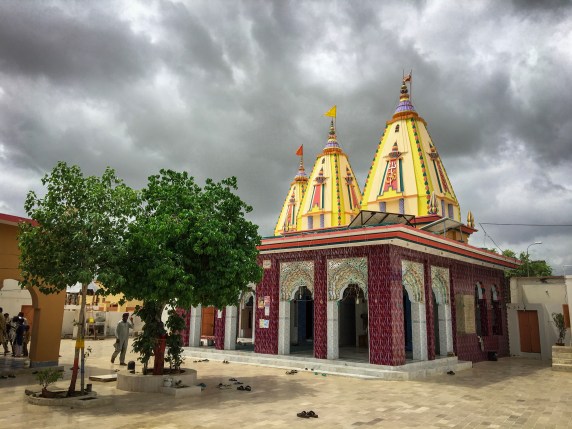
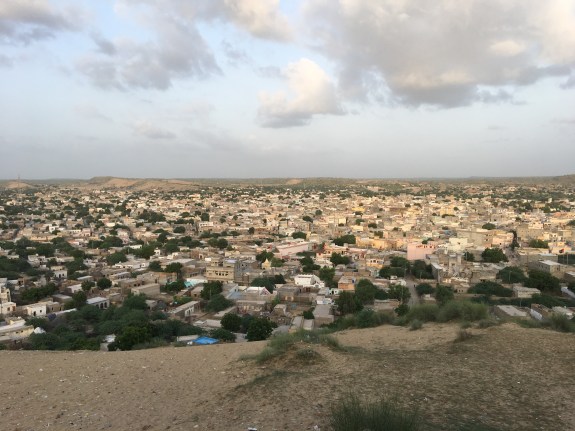
In the middle of the Thar desert in Pakistan, is lies a quaint town of Mithi. Other than the obvious natural beauty of the desert, the most fascinating thing about this town is the peaceful coexistence of the Hindu and Muslim residents. Both of the religions have existed here since centuries and have not let any external factors hinder their harmonious way of life.

IMG_0452

Mithi is located 280 kilometres away from Karachi, the largest city of Pakistan. It is one of the very few places in the country where Hindus outnumber Muslims. According to the local government estimates, the population of Mithi is around 87,000, out of which around 70 per cent are Hindus.

Unlike other rural areas of Pakistan, Mithi is a rather clean town. The crime rate in the town is almost negligible. There are mosques, there are temples and there are city squares which are inhabited by both religions.IMG_0482

“Whenever there is a religious festival or any cultural event, we all get together. When Hindus celebrate Deewali, they invite us, when we celebrate Eid, we invite them,” recalls Haji Muhammad Dal, a former school teacher and a theatre producer. He adds that the Hindu community takes part in Moharram processions and sometimes even fasts with Muslims. Muslims don’t sacrifice cows or eat beef in the city, out of respect for Hindus.

“In 1971, the Indian forces came all the way to Mithi, and we had to flee overnight,” says Dal, adding, “All the Hindus who lived with us got really upset and convinced us to come back to live with them.”_98282929_b56d9c81-37d0-40e2-8bef-9d031b070cf0

The Jamiya Masjid of Mithi was being expanded in 2001 and some land from the neighbour’s property was needed to fulfil the plans. “There was a Hindu lady residing in the house,” recalls Dal, “she came to me herself and insisted that we take her land for the mosque.” According to him she gave the land as charity because of her love for the Muslims.

Vishan Thari, also known as Mama Vishan, runs an extensive network of blood donors in Tharparkar. “Muslims give me a lot of respect, and are always willing to donate their blood without any discrimination,” he says.

Talking about the Hindu-Muslim unity, he recalls the time when Sadiq Faqeer, a renowned Sindhi singer, died in 2015. “It was Holi that day, but no one played with colours or celebrated. It felt like entire Mithi city was in sorrow that day.”

_98282930_b2d04a4a-6e30-4e80-b814-b2159be74ef4Kamla Poonam, who is a headmistress of a private school in Mithi, moved to this city from Hyderabad in Pakistan. She is happy that Hindus and Muslims live peacefully here. “People have been living here harmoniously since the very beginning. The elders are keeping the peaceful traditions alive. Even if the youth sometimes goes out of line, they are disciplined by the elder from both religions,” she says.

The level of tolerance exhibited by the locals is very uncommon for South Asia. As Haji Mohammad Dal says, “others should learn from Mithi how to spread love.”

Also published on BBC Hindi on 14 October 2017