
Here my colleague Farhat Javed Rabani and I, try to explain Pakistani elections to BBC’s Indian audiences through a quick explainer.
Pakistan’s Generation-Z goes to vote
by Faran Rafi
People born after mid-90s till mid-00s are called Generation Z. The Pakistani Generation Z will be voting in these elections for the very first time. Roughly 12 per cent of Pakistan’s population is between the ages of 18 to 24. We sat down with three individuals from Generation Z and asked them about the aspirations and expectations from the upcoming election.
Pakistan’s first blind judge set to take oath
by Faran Rafi
Yousaf Saleem from Lahore won a gold medal from University of Punjab in his law degree (LLB) in 2014. He then went on to practice law for two years, fulfilled all the requirements to become a judge and even topped the competitive exams out of 6500 applicants. But during the interview, he was failed and told that he could not become a judge. The reason? Yousaf is blind.
25-year-old Yousaf suffers from a rare genetic disorder called Retinitis Pigmentosa (or RP). Due to this, his vision was only 30-40 per cent when he was a child, but overtime it has completely deteriorated and now he only has light perception.
The chief justice of Pakistan, Justice Saqib Nisar, then took a suo motu notice of this and directed the Lahore High Court to reconsider the matter. His case was reconsidered by the selection committee and Yousaf was selected for the post. He is now set to become Pakistan’s first blind judge.
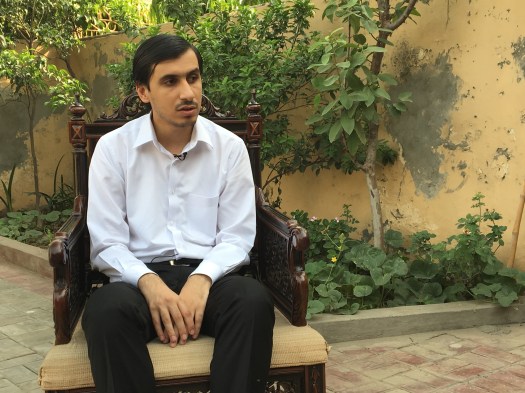
I met Yousaf at his home in Lahore. As he entered the room, I got up to help him find his way around and sit down. But before I could take a few steps, he swiftly manoeuvred his way through the room and came and sat next to me.
He talks to me about the hurdles that he faced in order to become a judge and his motivation to join this profession.
“I got interested in pursuing a law degree after my intermediate, it was time when there was a lawyer’s movement going on in Pakistan to restore the judiciary. I found the role of lawyers in that, very fascinating,” he says, adding that he also got inspired after reading about the prominent people involved in Pakistan movement, such as Mohammad Ali Jinnah and Dr Muhammad Iqbal, both of whom had studied law.
“I like practicing law, and I have done that too, but I feel being a judge is a better job because I will be directly able to make decisions according to the law and I will be able to provide justice to the people.”
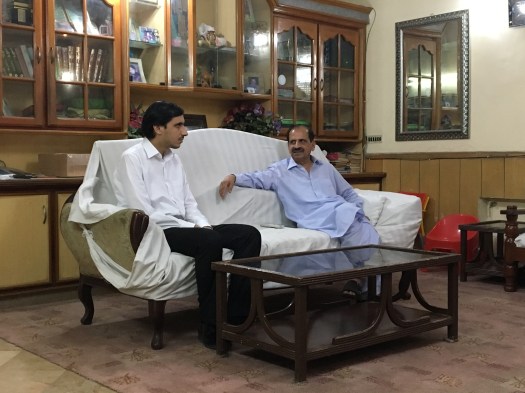
He believes that there are a lot of delays in Pakistan’s justice system. “Some people spend their entire lives, but they are still not able to get justice,” he says, citing a skewed ratio of number of judges to the number of case and delaying tactics as some of the reasons behind this.
Talking about his struggle as a visually impaired person, Yousaf says, “you know you can do things, but it is difficult for you to convince others that you can do them.” He mentions how sometimes people unnecessarily try to help him, without even asking if he needs help – something even I was guilty of doing a while ago.
He says that people with disabilities want to be treated normally and the society must make efforts to bring them to them mainstream. “As a person with disabilities, you have to prove every day that you can do all the things like everyone else, and that has been the hardest challenge of my life.”
Talking about his experience, he says, that even the most educated people sometimes have misconceived notions about persons with disabilities. He shares an anecdote about the time when this person kept asking Yousaf’s friend to act as interpreter between them, assuming that since Yousaf is visually impaired, he would also have problems speaking or hearing.
“One of our biggest problems in the society are that we do not want to communicate with people with disabilities. We don’t want to know how they work or how they want to be dealt by other people.”
When I ask him about his working method, considering a law degree requires a lot of studying, he tells me about JAWS (Job Access With Speech) software. “After the advancements in technology, people with visual impairment can read any book or article using this software,” he tell me, as his computer starts talking to him in a very robotic voice. As Yousaf presses some keys on his keyboard, the computer reads out the words that he is typing. This is how Yousaf got through his college and professional education, and even appeared in professional examinations.
He talks about how there are so many accessibility issues for visually impaired persons in Pakistan. All over the world, electronic copies of books are available, but there is no such mechanism in Pakistan. “Over here, I have to scan everything before reading, it is not like that in the rest of the world,” he says, adding that this might be the biggest hurdle he will face when he takes charge as a judge. “None of the court documents are available electronically.”
Despite all these difficulties, Yousaf is hopeful about the future and is very excited to take oath as a judge. For him, this is nothing extra-ordinary, as he comes from a family of highly accomplished people. Yousaf has two elder sisters, both of whom are also visually impaired. One of them is currently pursuing her PhD in Education. His other sister, Saima Saleem, was the first blind person to clear Pakistan’s civil services exam and then served for five years in Pakistan’s UN missions in Geneva and New York and currently works in the Prime Minister’s office in Islamabad.
Mithi: A unique story of interfaith harmony in Pakistan
In the middle of the Thar desert in Pakistan, is lies a quaint town of Mithi. Other than the obvious natural beauty of the desert, the most fascinating thing about this town is the peaceful coexistence of the Hindu and Muslim residents. Both of the religions have existed here since centuries and have not let any external factors hinder their harmonious way of life.
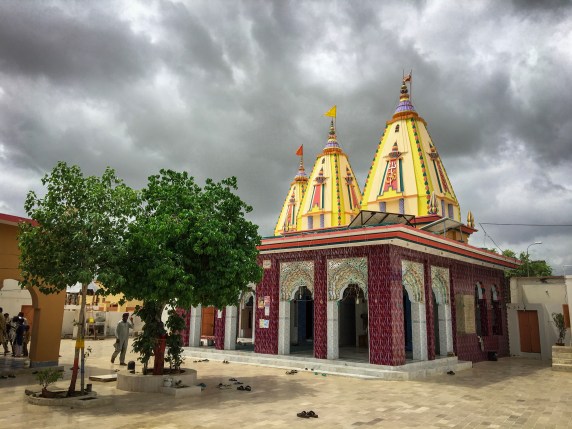
Mithi is located 280 kilometres away from Karachi, the largest city of Pakistan. It is one of the very few places in the country where Hindus outnumber Muslims. According to the local government estimates, the population of Mithi is around 87,000, out of which around 70 per cent are Hindus.
Unlike other rural areas of Pakistan, Mithi is a rather clean town. The crime rate in the town is almost negligible. There are mosques, there are temples and there are city squares which are inhabited by both religions.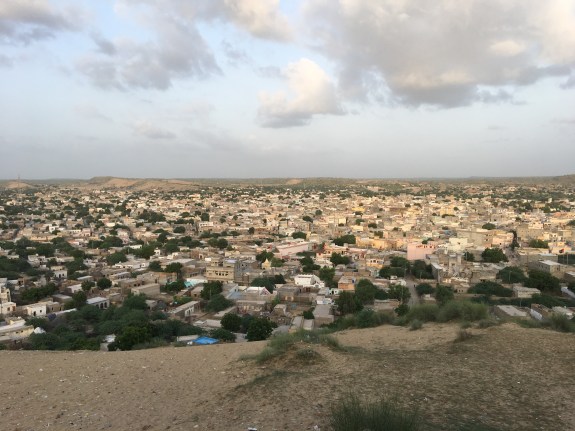
“Whenever there is a religious festival or any cultural event, we all get together. When Hindus celebrate Deewali, they invite us, when we celebrate Eid, we invite them,” recalls Haji Muhammad Dal, a former school teacher and a theatre producer. He adds that the Hindu community takes part in Moharram processions and sometimes even fasts with Muslims. Muslims don’t sacrifice cows or eat beef in the city, out of respect for Hindus.
“In 1971, the Indian forces came all the way to Mithi, and we had to flee overnight,” says Dal, adding, “All the Hindus who lived with us got really upset and convinced us to come back to live with them.”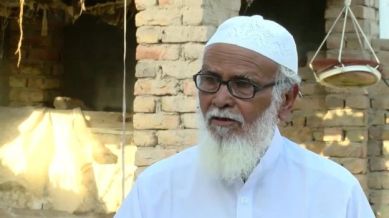
The Jamiya Masjid of Mithi was being expanded in 2001 and some land from the neighbour’s property was needed to fulfil the plans. “There was a Hindu lady residing in the house,” recalls Dal, “she came to me herself and insisted that we take her land for the mosque.” According to him she gave the land as charity because of her love for the Muslims.
Vishan Thari, also known as Mama Vishan, runs an extensive network of blood donors in Tharparkar. “Muslims give me a lot of respect, and are always willing to donate their blood without any discrimination,” he says.
Talking about the Hindu-Muslim unity, he recalls the time when Sadiq Faqeer, a renowned Sindhi singer, died in 2015. “It was Holi that day, but no one played with colours or celebrated. It felt like entire Mithi city was in sorrow that day.”
 Kamla Poonam, who is a headmistress of a private school in Mithi, moved to this city from Hyderabad in Pakistan. She is happy that Hindus and Muslims live peacefully here. “People have been living here harmoniously since the very beginning. The elders are keeping the peaceful traditions alive. Even if the youth sometimes goes out of line, they are disciplined by the elder from both religions,” she says.
The level of tolerance exhibited by the locals is very uncommon for South Asia. As Haji Mohammad Dal says, “others should learn from Mithi how to spread love.”
Bijli – The Social Worker
Bijli is a renowned transgender woman from Islamabad. She is famous throughout the city for her social work and charity that she does. She is also known for spreading smiles everywhere with her infectious jokes and banter! This is her story…
Originally published on BBC Punjabi.
Pakistan’s first all-women comedy troupe
Also published on BBC Hindi website.
Basant in Quetta
In most parts of Pakistan, people are banned from celebrating the spring festival of Basant. It is mostly due to the kite strings strangling the necks of people who are walking in narrow streets or going past in motorcycles.
I was in Quetta earlier this year, and saw so many kids celebrating basant, because there are no laws against it in the city!


Also published in Mangobaaz.
Renovations in Walled City of Lahore
Originally produced for BBC Hindi.
Ziarat’s Depleting Juniper Forests

This is a nursery of the forest department of Baluchistan, where they are trying to grow Juniper plants.

The forest department has had very little success in growing the plants.

It is very hard to grow juniper plants in Ziarat. The yield of the seeds is very low!


These trees are being cut down for fuel and construction by the locals.

Some of these trees can only survive here because of the cold climate.

Some of these trees are the oldest living creatures on this planet. That is why they are sometimes called “living fossils” and can be used to study changes on earth over time.

Some of these trees are as old as 3000-4000 years


These photographs are a part of a photo-essay published on BBC World.
Lahore’s Street Food
by Faran Rafi
I spent an entire day in Lahore, from breakfast to dinner, trying different famous street foods of the city. I tried my best to keep everything vegetarian.. but caved in after seeing that Tawwa Chicken for dinner!
This report was originally produced for BBC Hindi.
 FARAN RAFI